Four out of every five pesos were kept under DPWH Central Office When Ombudsman Jesus Crispin Remulla called Davao City the “epicenter” of flood-control spending before the Marcos administration, the statement immediately became political ammunition.
But beneath the politics is a more precise question: Who actually controlled the flood-control money? A briefing prepared by the Office of Rep. Isidro Ungab provides a nine-year breakdown based on DPWH GAA schedules and the FY2027 NEP.
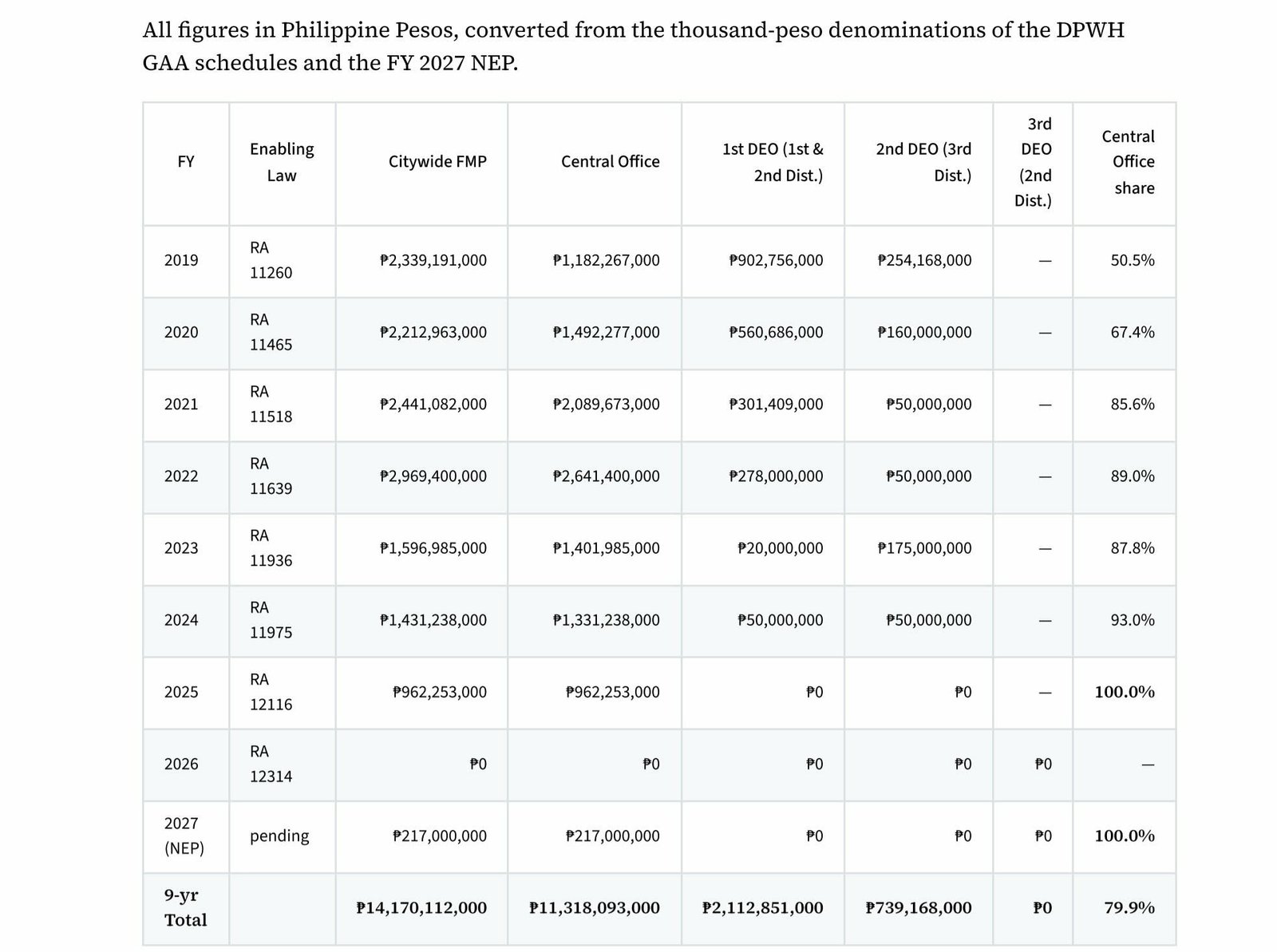
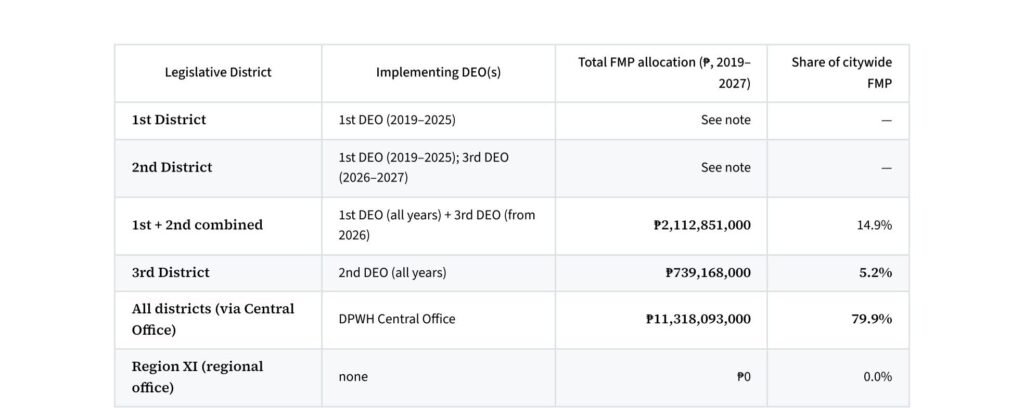
Its finding is striking. From fiscal year 2019 through the proposed 2027 budget, Davao City was programmed to receive approximately ₱14.17 billion under the Flood Management Program. Of that amount, ₱11.318 billion—or 79.9%—was assigned for direct implementation by the DPWH Central Office.
The Davao City 1st District Engineering Office received ₱2.113 billion, or 14.9%. The 2nd District Engineering Office received ₱739.168 million, or 5.2%.
The 3rd District Engineering Office received zero. There was also no separate Flood Management Program allocation assigned to DPWH Region XI as an independent implementing tier.
That changes the way the Davao flood-control controversy should be examined. This is not simply a story about Davao receiving a large amount of money.
It is a story about centralized implementation. The Central Office takeover did not happen overnight In 2019, Central Office controlled 50.5% of Davao City’s Flood Management Program.
In 2020, the share rose to 67.4%. In 2021, it reached 85.6%. In 2022, 89%. It remained at 87.8% in 2023, climbed to 93% in 2024 and reached 100% in 2025.
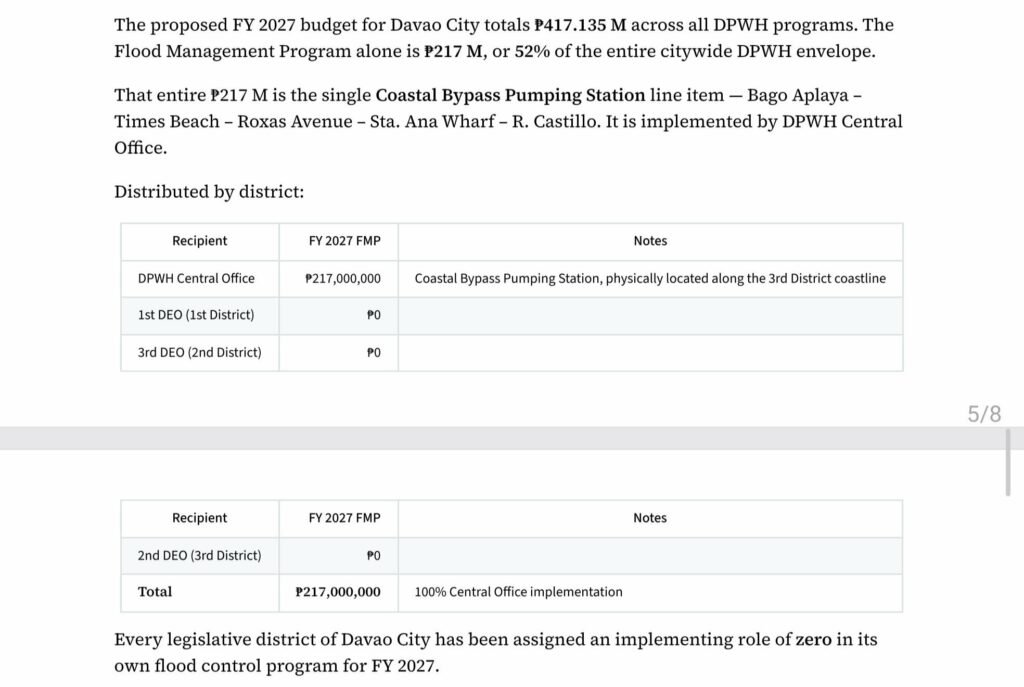
The proposed 2027 budget again assigns 100% of the city’s Flood Management Program allocation to Central Office.
That is not a one-year anomaly. It is a seven-year institutional trajectory toward centralization.
And it raises a basic governance question, why were Davao’s own district engineering offices progressively given less authority over flood-control projects physically located in their own communities? Projects in Davao. Authority in Manila.
The Central Office allocation was not merely a bookkeeping entry. The briefer identifies projects physically located across Davao City but assigned to Central Office.
They include the Lipadas River revetment in Toril; Talomo River projects; Mintal Creek; La Verna Creek; Bunawan River; Panacan River; Davao River; Matina River; and the Coastal Bypass pumping station. In other words, Davao was the location.
Central Office was the implementing authority. The practical consequence is significant. The office controlling implementation generally controls the procurement process, project supervision, payment processing and much of the official documentation surrounding the project.
That does not make centralized implementation improper. Large and technically complex projects can legitimately require national-level implementation.
But if Central Office claims that it can implement these projects better than local engineering offices, then that claim should be measurable.
Were Central Office projects completed faster? Were they cheaper? Did they have fewer variations? Fewer slippages? Better physical accomplishment? Fewer COA findings?
Those are questions that can be answered through records. But public record does not support that presumption, for DPWH Central Office is carrying an estimated ₱30.36 billion in unused funds — the largest unobligated balance in the national government.
As of end-February in the current cycle, only about 12 percent of the FY 2026 DPWH budget had been released.
DPWH’s own historic obligation and disbursement rates have consistently ranked among the lowest in the top-tier line agencies.
If Central Office were genuinely a faster and more competent implementer than the district engineering offices, its unused balance would be shrinking, not accumulating.
The pattern instead suggests that centralized implementation is a mechanism for retaining political and procurement discretion in Manila, not a mechanism for faster or better flood infrastructure in Davao City.
The 2025 endpoint The clearest example came in FY2025. Davao City had ₱962.253 million programmed under the Flood Management Program.
Every peso was assigned to Central Office. The local DEOs received nothing.
The projects included: • ₱151.181 million for flood mitigation protecting the Davao Coastal Bypass;
• ₱100 million for Ilang Creek; • ₱211.072 million for the La Verna Creek retarding basin; • ₱100 million for Davao River revetments; and • ₱400 million for Lasang River revetments.
Nearly ₱1 billion in flood infrastructure in Davao City—without a single local DEO receiving implementing authority for a named Flood Management Program project.
That deserves scrutiny. Not because Central Office is automatically guilty of anything. But because centralization creates a centralized accountability chain.
If Manila controls the money, Manila should also be prepared to show the public, project by project: Who proposed it? Who approved it? Why was Central Office chosen? Who bid for it? Who won? How much was paid? When was it completed? Was it physically completed? And did it actually reduce flooding?
Those questions should be answered before anyone turns the Davao flood-control controversy into either a political conviction or a political exoneration.
The real investigation The most important number may therefore not be ₱51 billion. It may be 79.9%. Because that number tells us something about institutional control.
The next step is not another political speech. It is a project-level audit of the ₱11.318 billion controlled by Central Office.
If the projects are legitimate, completed and effective, the documents should establish it. If there were irregularities, the same documents should reveal where.
Either way, the paper trail for the Ombudsman’s supposed probe on Davao City as the epicenter of flood control corruption should begin in Manila.