TAGUM CITY | For decades, the province of Davao del Norte lived under the shadow of the communist insurgency, where armed conflict pushed back development, isolated communities, and deprived the people of economic opportunities they rightfully deserved.
Today, that story of Davao del Norte is being re-written.
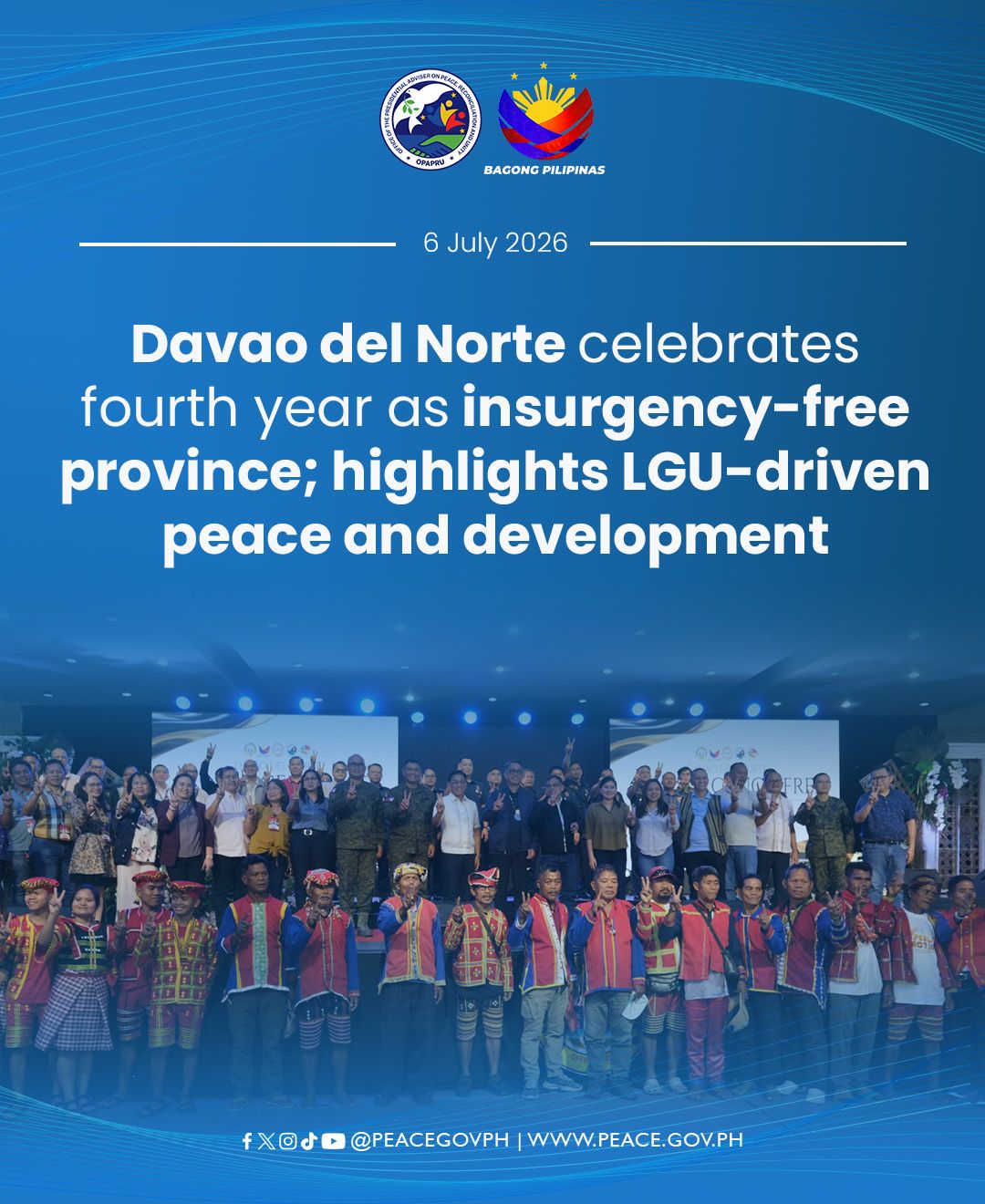
On July 3, Davao del Norte celebrated its fourth anniversary as an insurgency-free province, an occasion that brought together national government officials, local chief executives, representatives from the security sector, community leaders and former rebels-turned-peace advocates who have been instrumental in the province’s remarkable transformation.
Four years after being officially declared insurgency-free, the province has emerged as one of Mindanao’s shining examples of how local-government driven peace and development can transform lives and spur economic development.
Roads now connect once-isolated villages, investors are looking at the area with a fresh eye, and indigenous communities are gaining greater access to education, healthcare, housing, and other essential government services.
More importantly, local leaders say the province has sent a clear and strong message that lasting peace is built not only by ending armed conflict, but by ensuring that every community feels the dividends of peace and development.
Winning the peace through gov’t presence
For Davao del Norte Governor Edwin Jubahib, the province’s greatest achievement was not putting an end to the decades-long insurgency but decisively addressing the conditions that allowed it to thrive.
According to the Jubahib, instead of relying solely on security operations, the provincial government carried out an aggressive whole-of-nation approach that brought government services directly into geographically isolated and disadvantaged areas, particularly ancestral domains that had long remained beyond the reach of basic public services.
The governor said his administration focused on building roads where none existed, establishing schools and health facilities, and launching housing projects and livelihood initiatives in communities that had long been on the margins of development.
“Our insurgency-free status did not happen overnight, nor was it accomplished by a single institution. It is the result of years of dedication, trust, coordination, and unwavering commitment among our partner agencies,” Jubahib said.
The three-term governor credited the combined efforts of local governments, the Armed Forces of the Philippines, the Philippine National Police, national government agencies, village officials, and residents themselves for sustaining peace across the province.
“Dahil ang pagbigay ng solusyon sa problemang ito ay hindi kayang gawin ng isa,” he stressed. “Dapat lahat magtulungan.”
Today, Jubahib said, the province has effectively stopped the recruitment efforts of the communist group, as it continues to implement programs that aim to strengthen the resilience of communities.
“We are absolutely certain of zero recruitment. Davao del Norte is ready for development,” he declared, with pride in his voice.
Peace, the ‘greatest formula’
For Mindanao Development Authority Chairman (MinDA) and Secretary Leo Tereso Magno, Davao del Norte offered a definite answer to one of the oldest questions facing development planners: Which comes first, peace or progress? His answer was unequivocal.
“Peace is the greatest formula,” Magno said. “Peace is the greatest ingredient. It is the only ingredient, actually, that we need for development.”
He described the province’s insurgency-free declaration in 2022 as a historic turning point for the province that laid the foundation for stronger government institutions, inclusive economic growth, and improved quality of life of residents.
“Peace became the foundation of inclusive growth. Peace became the foundation for greater opportunities,” he noted.
According to Magno, the benefits of peace are now visible in everyday life, as farmers cultivate their land without fear, businesses invest with confidence, tourists travel freely, and families can finally plan for a more stable future.
The improved security situation, he said, has also strengthened investor confidence across the Davao Region, with international business delegations increasingly looking to Mindanao as a viable destination for investment.
“Panahon na ng kaunlaran,” Magno said, as he asked, “What better province to stand as a model all over the country than the Province of Davao del Norte?”
Beyond the absence of conflict
Representing the Office of the Presidential Adviser on Peace, Reconciliation and Unity, Presidential Assistant Attorney Wilben Mayor said that Davao del Norte serves as a perfect example of “positive peace,” a condition where security is reinforced by effective governance, inclusive development, and expanding economic opportunities.
Mayor said the province’s experience demonstrates that military gains become sustainable only when they are supported by responsive public institutions and tangible improvements in the people’s lives.
“Ang inyong kapansin-pansing pagbabago mula sa isang lugar na dating nakaranas ng tunggalian tungo sa isang ehemplo ng kapayapaan at kaunlaran ay nagpapaalala sa atin na ang tunay na pagbabago ay posible kapag magkatuwang ang pamahalaan at mga mamamayan,” Mayor said.
He emphasized that the challenge facing Davao del Norte has shifted from winning the peace to ensuring that every family experiences its dividends.
“Hindi sapat na mapanatili nating insurgency-free ang ating mga pamayanan. Ang tunay na hamon ay ang pagtitiyak na mararamdaman ng bawat pamilya at bawat komunidad ang mga bunga ng kapayapaan,” he emphasized
Mayor stressed that peace cannot simply be measured by the absence of armed conflict.
“Ang tunay na kapayapaan ay ang pagkakaroon ng mas maraming oportunidad upang umunlad, makapagtrabaho nang marangal, at makabuo ng mas magandang kinabukasan,” he said.
He underscored that Davao del Norte has shown that enduring peace is achieved through good governance, inclusive development, and a shared commitment to improving the lives of ordinary citizens.
A model for lasting peace
The celebration also featured the official launching of Davao del Norte “Kalinaw” Peace and Development Center, which will serve as the central hub of the province’s peacebuilding interventions.
To support the center’s operations, the OPAPRU has turned Php 17.5 million to the provincial government, which will be used to fund the facility’s peace and development programs, especially for former rebels (FRs), their families and communities.
Peace and development centers are dovetailed to the OPAPRU’s Transformation Program, which aims to ensure the successful transition of FRs into peaceful, productive and empowered members of society.
Through the Transformation Program, hundreds of FRs now walk the path of peace and have organized themselves into people’s organizations, which are now engaged in various business ventures that allow them to earn sustainable incomes and support the needs of their families. (PR-OPAPRU)