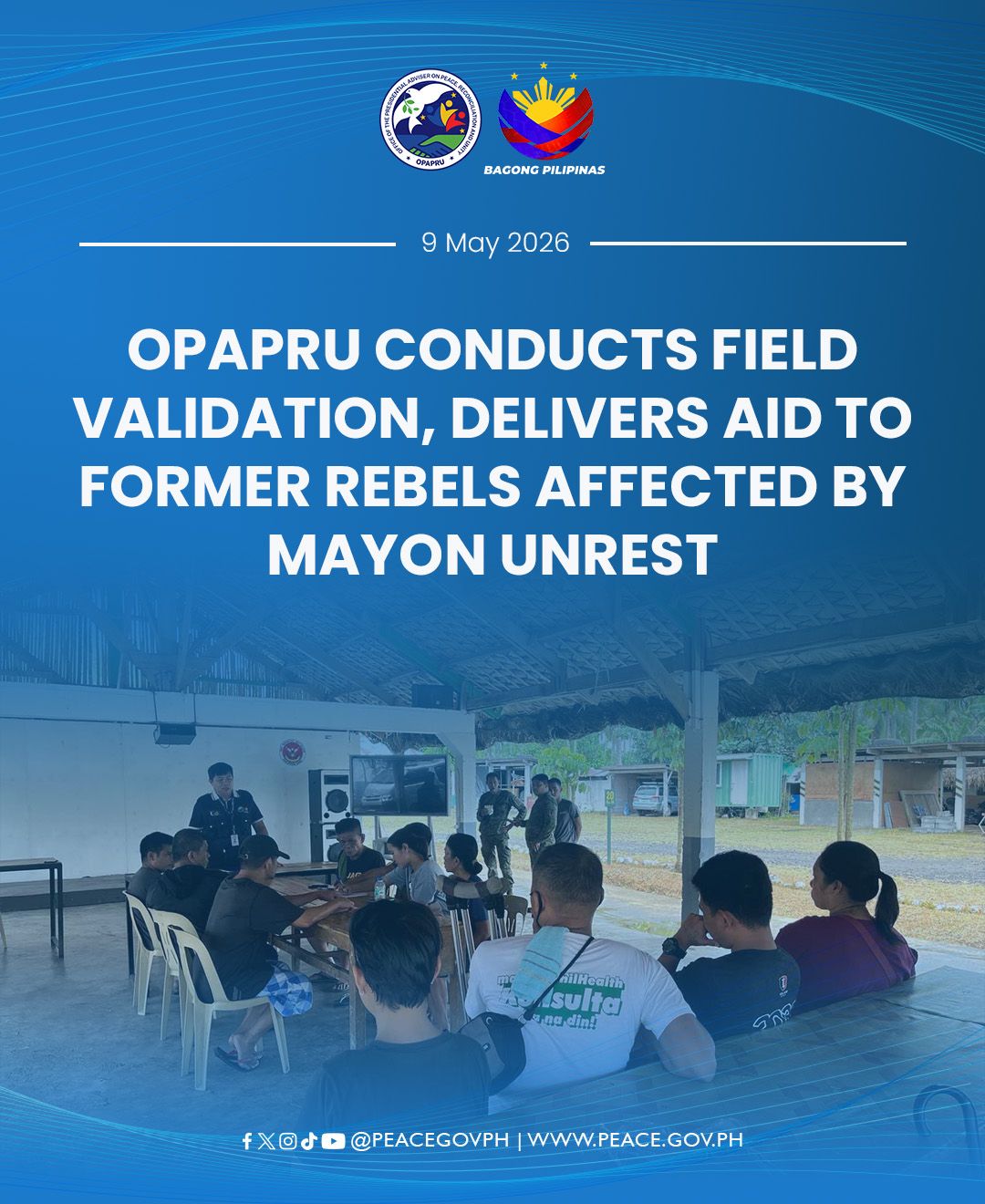
PASIG CITY – The Office of the Presidential Adviser on Peace, Reconciliation and Unity (OPAPRU) has completed a series of field assessments as well as provided initial relief assistance to former rebels (FRs) who have been affected by the recent eruption of Mayon Volcano.
These interventions are in line with the directive earlier issued by Presidential Peace Adviser Secretary Mel Senen Sarmiento to conduct an on-the-ground validation of the situation of FRs and conflict-affected communities in the Bicol region.
“The directive from President Ferdinand Marcos Jr. was clear: conduct actual field visits, validate conditions on the ground, and make sure that immediate assistance reaches affected communities. This is part of our continuing commitment to stand with our former rebels, especially during emergencies and disasters,” he said.
As of posting, there were nine affected former rebels who have been visited and interviewed by OPAPRU in coordination with the Department of Social Welfare and Development (DSWD), Local Government Units (LGUs), and other concerned agencies. Eight out of nine affected FR-PO (Former Rebels – Peoples Organization) members were engaged by the agency and the Armed Forces of the Philippines (AFP) through a consultation and assessment meeting.
The field validation also confirmed that all affected individuals were safe and accounted for, and that no critical incidents, casualties, or major property damage were reported among the FRs and their families.
On May 2, Mayon Volcano unleashed significant ashfall and pyroclastic density currents which affected at least 52 barangays, including communities in Camalig, Guinobatan, Ligao City, Daraga, and Legazpi City, disrupting daily activities and prompting immediate monitoring and response efforts from concerned government agencies.
“We need to determine their immediate needs and provide appropriate interventions to guarantee their safety, welfare, and recovery,” he added.
The peace adviser also emphasized that the response effort reflects the government’s commitment to protect conflict-vulnerable communities, particularly FRs who are undergoing the transformation and reintegration process so that no one is left behind during times of crisis.
Sarmiento said that sustained field engagements and direct coordination with local stakeholders are essential in ensuring that government interventions translate into tangible support for communities that are affected by both conflict and natural calamities. (PR)#